Post
Why Physical AI Is the Next Startup Frontier
Artificial intelligence has spent the last decade transforming software.
Why Physical AI Is the Next Startup Frontier
Artificial intelligence has spent the last decade transforming software.
Large language models write emails. Recommendation systems shape what we watch and buy. AI copilots help engineers write code and analysts generate reports. The internet is now layered with intelligent systems that interpret information and assist humans in digital environments.
But the next wave of artificial intelligence is not going to live purely inside screens.
It is going to move into the physical world.
Robots that move through warehouses. Autonomous vehicles navigating complex cities. Intelligent machines assisting surgeons, inspecting infrastructure, or building factories.
In other words, the next generation of AI will not just process information.
It will interact with reality.
This shift toward what many are calling Physical AI represents one of the most important technology transitions of the coming decade.
And it is already underway.
At SF Playground, we are building a community around the founders, engineers, and investors working on this frontier.
The Shift From Software AI to Physical AI
For most of its recent history, artificial intelligence has been primarily a software discipline.
Models were trained to classify images, generate text, predict outcomes, or optimize digital systems. These breakthroughs were incredibly powerful, but they mostly affected virtual environments.
Today that is changing.
AI models are increasingly being paired with hardware systems capable of sensing, moving, and acting in the real world.

This transformation is happening across industries.
Warehouse robots are automating logistics and fulfillment centers. Autonomous drones are performing inspections of power lines and construction sites. Manufacturing systems are becoming increasingly flexible through AI powered robotics.
Humanoid robots are beginning to assist in environments designed for humans. Autonomous vehicles continue to advance in both commercial and consumer applications.
These systems combine several major technologies:
- machine learning models
- computer vision systems
- robotics hardware
- sensor fusion
- edge computing
Together they enable something fundamentally new.
Artificial intelligence that does not just analyze the world.
But acts within it.
The Infrastructure That Made It Possible
Physical AI has been discussed for decades, but historically the technology stack required to build it was incomplete.
Three major breakthroughs are changing that.
First, modern AI models are far more capable than previous generations. Vision models can now interpret complex scenes, identify objects in dynamic environments, and assist with navigation and manipulation tasks.
Second, simulation environments have become dramatically more advanced. Robotics companies can now train machines inside virtual worlds before deploying them in physical environments.
This dramatically accelerates learning while reducing cost and risk.
Third, compute infrastructure has improved dramatically.
Powerful GPUs, edge computing systems, and specialized AI hardware allow real time decision making directly on machines operating in the physical world.
Together these advances create the foundation required to build intelligent systems that can perceive, reason, and act.
NVIDIA GTC and the Rise of Physical AI
This shift was on full display at NVIDIA GTC, one of the largest AI conferences in the world.

Each year, thousands of engineers, researchers, and startup founders gather to explore the latest advances in AI infrastructure.
Increasingly, the focus of these conversations is shifting beyond traditional software AI.
Key themes emerging from recent conferences include:
• robotics platforms
• simulation environments for training machines
• autonomous systems
• edge AI computing
• real time machine learning pipelines
Many of the most exciting demonstrations involve systems where AI models directly control physical machines.
Robots trained in simulation environments that learn complex tasks. Autonomous systems capable of navigating unpredictable environments. Hardware platforms designed specifically to support real time AI workloads.
These developments are accelerating rapidly.
And they signal that Physical AI is moving from research labs into real products.
Why Startups Are Moving Fast
Large technology companies are investing billions into robotics and automation.
However, historically the most transformative innovation in emerging technology sectors often comes from startups.

Startups have the ability to experiment quickly, explore new ideas, and build specialized systems that large organizations may overlook.
We are already seeing Physical AI startups emerge across many sectors.
Logistics
Autonomous warehouse robots are reshaping global supply chains by increasing efficiency and reducing labor intensive tasks.
Manufacturing
AI powered robotics are enabling more flexible factories capable of producing customized products at scale.
Healthcare
Robotics combined with AI is improving surgical precision, diagnostics, and patient care.
Agriculture
Autonomous machines are transforming how crops are monitored, harvested, and managed.
Construction
Robots are beginning to automate dangerous and repetitive work in building and infrastructure development.
These companies are not theoretical.
They are already raising capital, deploying products, and building entirely new markets.
The New Builder Stack
Building a Physical AI startup requires a very different technical stack than traditional software startups.
Founders in this space must combine several layers of technology.
AI Models
These include vision models, reinforcement learning systems, and control models capable of interpreting environments and making decisions.
Robotics Hardware
Sensors, actuators, embedded processors, and specialized hardware enable machines to move and interact with their surroundings.
Simulation
Training robots in virtual environments allows rapid experimentation before deployment in the real world.
Infrastructure
GPU clusters, edge compute devices, and real time data systems support these machines in operation.
This stack creates a unique intersection of software engineering, hardware development, and artificial intelligence research.
It also creates enormous opportunities for founders willing to tackle complex real world problems.
Why the Bay Area Matters
The Bay Area is rapidly becoming one of the central hubs for the Physical AI ecosystem.

Few regions combine the ingredients necessary to support this type of innovation.
The region benefits from:
• world class research institutions
• leading AI companies
• robotics startups
• venture capital funding
• deep engineering talent
Major conferences like NVIDIA GTC bring together thousands of builders working on these technologies.
But conferences alone are not enough to build communities.
What founders and engineers often need most is something simpler.
A place where builders can meet regularly, show what they are building, and connect with the people who can help them move forward.
Enter SF Playground
SF Playground was created to support exactly this type of ecosystem.
We bring together founders, engineers, and investors working on the future of Physical AI.
Our events are designed to highlight real builders working on real products.
Founders can:
• showcase prototypes
• demo hardware systems
• pitch early stage startups
• connect with investors
• meet other builders
Unlike traditional startup pitch events, founders at SF Playground do not just present slides.
They show real products.
Attendees receive three voting tokens at check in that they can use to invest in the startups they believe in.
At the end of the night, the community determines which startup receives the most support.
Pitch Playoff #002
Our next event is Pitch Playoff #002.
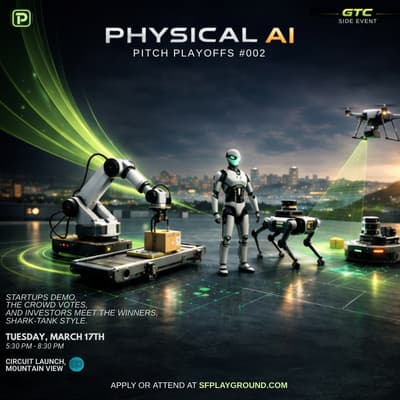
The event will bring together builders from across the Physical AI ecosystem.
Expect to see:
• early stage startups
• robotics demonstrations
• AI hardware prototypes
• engineers and founders from across the Bay Area
Whether you are a founder, engineer, investor, or simply curious about the future of artificial intelligence, SF Playground provides a place to meet the people building this new generation of technology.
The Future of AI Is Physical
Software AI has already changed how humans interact with information.
Physical AI will change how machines interact with the world.
Robots may help build infrastructure, maintain cities, harvest crops, and transport goods.
Autonomous systems may assist in disaster response, healthcare, manufacturing, and exploration.
Machines will increasingly work alongside humans in environments that were once considered impossible to automate.
The founders building that future are starting today.
And many of them are already gathering in communities like SF Playground.
Join the Community
SF Playground is bringing together the builders shaping the next generation of technology.
You can:
• attend events
• apply to pitch
• meet investors
• discover early stage startups
If you are building in robotics, hardware AI, or physical automation, we would love to meet you.
Stay Connected
🌉 Website
https://sfplayground.com
📅 Pitch Playoff Series
https://luma.com/82fwu1tc
🚀 Community
Founders • Builders • Investors
SF Playground
Where the future of Physical AI gets built.